







- Site Navigation -
Tricycles Used in Construction Sites: Material Handling Performance and Selection Guide
Author:duomi Date:2026-07-02 15:54:27 Hits:145

Construction site logistics is a persistent operational bottleneck: 30–40% of on-site labor hours are spent on material movement rather than installation work. Within this context, tricycles used in construction sites have proven their value as efficient, cost-effective material transport vehicles that replace 4–6 wheelbarrow operators per unit while operating on the compacted surfaces, paved access roads, and interior slabs that characterize active building sites. This guide provides construction managers and procurement professionals with the technical and economic framework for selecting and deploying construction tricycles that deliver measurable improvements in site productivity, labor cost reduction, and worker safety.
Construction Site Material Transport Challenges
Construction sites present a unique operating environment for cargo tricycles that differs substantially from warehouse or road-based logistics. Key site characteristics include: variable surface quality (compacted earth, gravel, concrete slab, steel decking), limited maneuvering space (between formwork, scaffolding, and stored materials), elevation changes (ramps between ground and upper floors, inclined site access roads), and dust and debris exposure that accelerates component wear. A construction tricycle must be specified for these conditions—not adapted from a road-going cargo model. Site-grade specifications include: ground clearance ≥150 mm, full chain enclosure with debris shielding, sealed bearings at all pivots, pneumatic tires rated for rough surfaces (4–6 ply, puncture-resistant), and frame finishes with corrosion-resistant coating or powder coating rated for outdoor exposure.
Dump Bed Tricycles for Bulk Material Transport
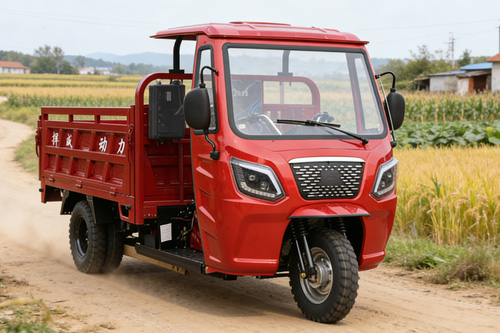
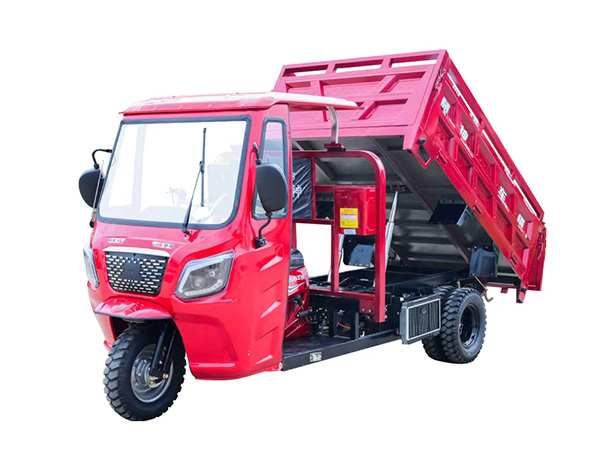
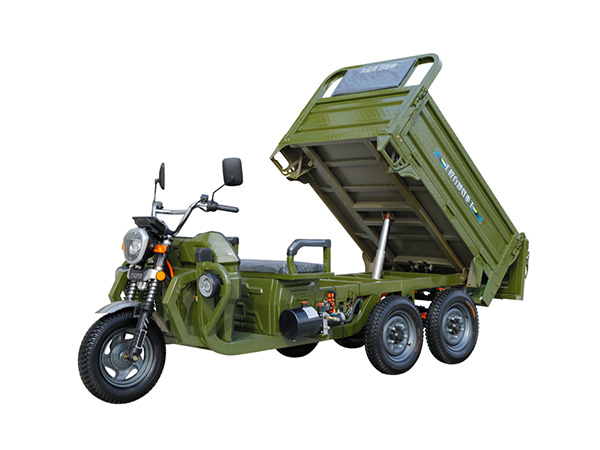
The dump bed construction tricycle is the most widely deployed configuration for bulk material handling on construction sites. Its primary application is moving sand, gravel, crushed stone, soil, concrete mix, and demolition debris between storage piles, mixing stations, and work points within the site. The dump mechanism enables gravity-assisted unloading in 15–45 seconds—compared to 3–8 minutes for manual shoveling from a flatbed—making dump tricycles the standard choice for high-volume bulk material cycles. For a construction tricycle handling 500–700 kg of sand or gravel per trip across a 50–100 m site route, the dump configuration reduces cycle time by 70–80% and increases daily tonnage moved by 3–5× compared to wheelbarrow transport. Specify hydraulic-actuated dump mechanisms for loads exceeding 400 kg to reduce operator effort and enable controlled partial dumping for precise material placement.
Flatbed Models for Unitized Construction Materials
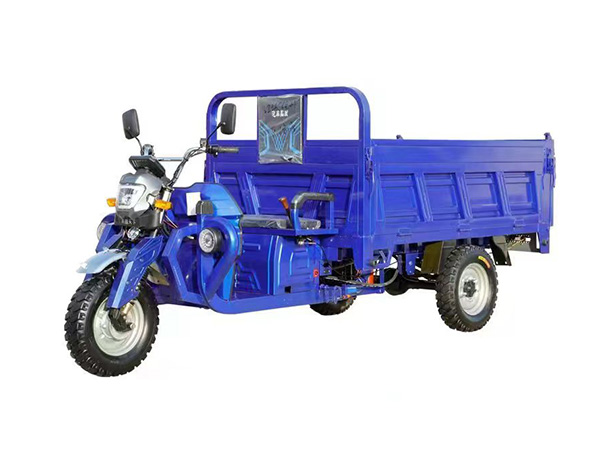
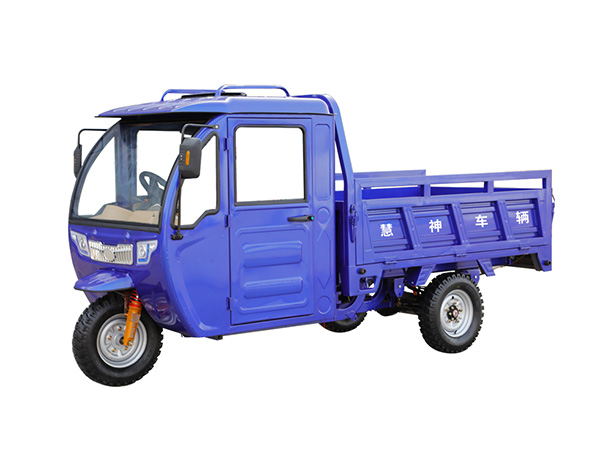
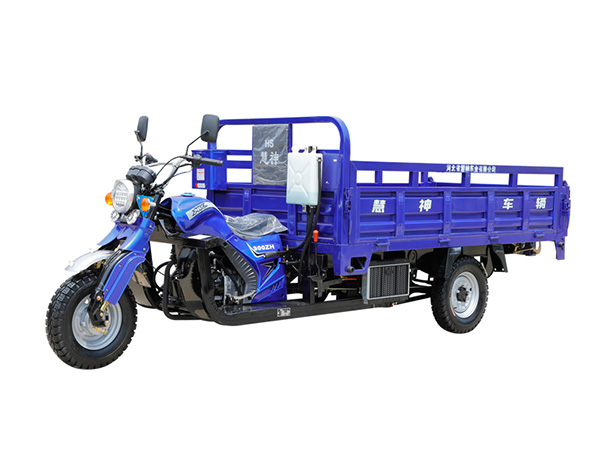
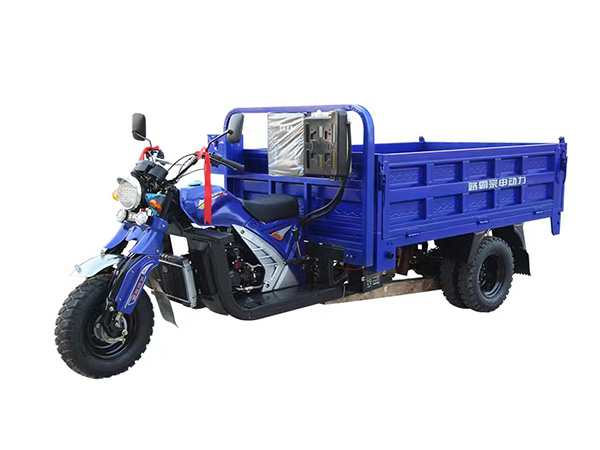
For unitized construction materials—cement bags, bricks, steel reinforcement bars, timber, plumbing fixtures, and tool bins—a flatbed construction tricycle offers maximum cargo configuration flexibility. The flat platform accepts standard pallets (EUR 1200 × 800 mm or US 1200 × 1000 mm), loose materials secured with ratchet straps, and custom fixtures for specific material types (pipe racks, rebar cradles). Flatbed tricycles used in construction sites typically carry 300–600 kg on a 1,400 × 900 mm platform, with optional drop-side panels for easy loading from above or sides. For multi-story construction, the flatbed configuration is preferred for elevator transport—the compact dimensions (total length ≤2,400 mm, total width ≤1,000 mm) fit standard construction elevators and hoists for floor-to-floor material distribution.
Heavy-Duty Specifications for Construction-Grade Durability
Construction-grade tricycles require specifications that exceed general-purpose industrial models by 30–50% in structural strength. The construction environment imposes impacts, vibration, dust infiltration, and load cycling that accelerate wear on standard components. Key heavy-duty specifications include: frame material Q345 steel minimum (yield strength ≥345 MPa), with reinforced gussets at all high-stress joints; rear axle assemblies rated for 1.5× maximum payload per wheel; 26-inch wheels with 6-ply tires (rated for loads of 545+ kg per tire); hydraulic disc brakes on all three wheels (minimum 180 mm front, 203 mm rear rotors) for consistent stopping under 700+ kg loads on site grades; and a grease-able full chain enclosure with debris shielding to prevent dust and grit contamination. The additional cost for construction-grade specifications over standard industrial models is typically 15–25%, but the extension of service life from 5–6 years to 8–12 years under construction conditions delivers a 3:1 return on the durability premium.
Multi-Story Building Material Distribution
A specialized but increasingly important application of tricycles used in construction sites is multi-story building material distribution. Once materials are delivered to a building by crane or elevator, they must be distributed from the landing point to the specific work location on that floor—a distance of 20–100 m through partially completed corridors. A construction tricycle performs this function 3–4× faster than manual carrying and reduces worker fatigue and injury risk for repetitive material transport. For multi-story deployment, specify: compact dimensions fitting standard construction elevator cabins (length ≤2,400 mm, width ≤900 mm), a weight (vehicle + typical cargo) within the elevator's load rating, non-marking tires for finished floor protection, and a low-voltage electric-assist system rated for safe indoor operation without exhaust emissions. Some high-rise projects deploy dedicated floor-level construction tricycles that remain on a single floor for the duration of that floor's construction phase, eliminating inter-floor transport logistics.
Safety Protocols for Construction Tricycle Operations
Construction site safety regulations require that tricycles used in construction sites be operated under the same hazard management framework as other material handling equipment. Mandatory safety measures include: operator training covering load management, braking technique on slopes, and stability awareness (minimum 4-hour training program); maximum speed limits within the site (typically 10–12 km/h on paved surfaces, 5–8 km/h on compacted earth or gravel); prohibition of operation on scaffolding, structural steelwork, or any surface without a firm load-bearing base; mandatory high-visibility vest and hard hat for operators; and defined traffic management routes that separate construction tricycle paths from pedestrian and heavy vehicle traffic. Site managers who implement structured safety protocols for construction tricycle operations report 70% fewer material transport-related incidents compared to sites using ad-hoc wheelbarrow and manual carrying practices.
Frequently Asked Questions
What types of tricycles are used in construction sites?
The three primary tricycles used in construction sites are: dump bed models for bulk materials (sand, gravel, soil, debris), flatbed models for unitized materials (bricks, cement bags, timber, tools), and specialized rack models for long-length items (pipe, rebar, lumber). Dump beds dominate in earthwork and concrete phases; flatbeds dominate in finishing phases with diverse material types.
How much weight can a construction tricycle carry?
Construction-grade tricycles are rated for 300–800 kg payload depending on frame class and configuration. For daily sustained use, derate by 15–20% (working load of 250–650 kg). Dump bed models typically handle 400–700 kg of bulk material; flatbed models handle 300–500 kg of unitized cargo. Always verify that tire load index and axle ratings accommodate 1.5× the per-wheel load share of your maximum payload.
Can construction tricycles operate on rough terrain and unfinished surfaces?
Yes, with appropriate specifications. Construction tricycles with 26-inch wheels, 4–6 ply pneumatic tires, and ground clearance ≥150 mm operate effectively on compacted earth, gravel, and partially finished concrete surfaces. For very rough terrain (uncompacted fill, deep mud), specify wide-tread tires (2.0–2.5 inch width) and reduce payload by 25–30%. Avoid operation on uncompacted, water-saturated soil or slopes exceeding 10°.
What is the labor cost saving of a construction tricycle versus wheelbarrows?
A single construction tricycle replaces 4–6 wheelbarrow operators for equivalent material throughput, saving $200–$500 per day in labor costs (depending on local wage rates) after accounting for the tricycle operator's wage. At an average savings of $300/day and a 250 working-day year, annual labor savings reach $75,000 per unit—recovering the vehicle purchase cost ($1,500–$3,000) in under 2 weeks of operation.
Conclusion
The deployment of tricycles used in construction sites represents one of the highest-ROI material handling investments available to construction managers. A construction-grade tricycle replaces 4–6 wheelbarrow operators at a purchase price that pays back in under 2 weeks of labor savings, while simultaneously reducing worker fatigue and injury risk, improving material movement speed by 3–5×, and enabling continuous high-frequency bulk material transport that manual methods cannot match. The keys to success are specifying the right configuration (dump bed for bulk, flatbed for unitized), demanding construction-grade durability specifications, implementing structured safety protocols, and planning for the specific surface conditions and space constraints of your site. For any construction operation moving more than 2,000 kg of material per day within the site boundary, the economic case for construction tricycles is unambiguous.
References
Koskela, L., An Exploration Towards a Production Theory and Its Application to Construction, VTT Publications, 2000.
Szymberski, R., "Construction Site Safety Planning," Professional Safety, vol. 42, no. 2, pp. 30–34, 1997.
Cheng, E.W.L. et al., "Construction Site Safety Management: A Review," International Journal of Project Management, vol. 31, no. 8, pp. 1117–1126, 2013.
Jaselskis, E.J. et al., "Design of a Construction Safety Information System," Journal of Construction Engineering and Management, vol. 122, no. 1, pp. 49–58, 1996.

Contact Us
Tel:8615713172715 / 8619061777149
WeChat:8615713172715 / 8619061777149
E-mail:942778859@qq.com
Url:https://www.duomitricycle.com