







- Site Navigation -
Electric vs Fuel Powered Tricycle: A Data-Driven Comparison for Industrial Buyers
Author:duomi Date:2026-06-29 11:34:16 Hits:115
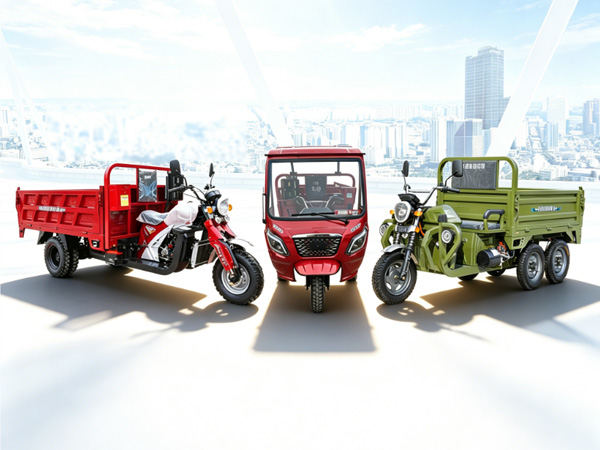
The choice between an electric tricycle and a fuel powered tricycle is one of the most consequential procurement decisions facing logistics and industrial operations today. It is not a simple environmental preference—it is a total-cost-of-ownership, operational capability, and regulatory compliance calculation that varies dramatically by use case. This comparison provides quantifiable performance data across the seven evaluation criteria that matter most to industrial buyers: energy cost per kilometer, payload capacity, range and refueling time, maintenance burden, regulatory compliance, noise and emissions profile, and service life economics.
Energy Cost: The Largest Long-Term Differentiator
Energy cost per kilometer is the single largest operational cost differential between an electric tricycle and a fuel powered tricycle. For an electric-assist or full-electric cargo tricycle equipped with a 500–750 W motor and a 48V/20Ah lithium battery, energy consumption averages 8–15 Wh per kilometer at 300 kg payload. At average industrial electricity rates ($0.08–$0.12 per kWh), this translates to $0.006–$0.018 per kilometer. A fuel powered tricycle with a 50–110 cc engine consumes 1.5–2.5 L per 100 km, equivalent to $0.10–$0.18 per kilometer at current fuel prices. Over a typical 50,000 km service life, the cumulative energy cost difference reaches $4,000–$8,000 per vehicle—often exceeding the initial purchase price premium of the electric model.
Payload Capacity and Power Delivery Characteristics
Power delivery characteristics differ fundamentally between the two powertrains. A fuel powered tricycle delivers consistent torque across its RPM range, making it well-suited for sustained heavy loads on grades exceeding 8–10% where electric motor thermal derating can reduce output by 15–25%. An electric tricycle delivers peak torque instantly (0 RPM), providing superior acceleration from rest and superior low-speed load handling on flat terrain. For payloads under 500 kg on grades under 5%, electric and fuel models perform equivalently. For payloads of 500–1,000 kg on routes with sustained 8–12% grades, fuel-powered models maintain power output more consistently, though modern high-wattage electric models (1,000–1,500 W) with appropriate thermal management are closing this gap.
Range, Refueling Time, and Charging Infrastructure
Range capability remains the most significant operational constraint for electric tricycles. A typical 48V/20Ah lithium battery pack provides 40–70 km range under 300 kg payload, with charging times of 4–6 hours from a standard 240 V outlet. A fuel powered tricycle with a 5 L tank provides 80–150 km range with refueling time of under 2 minutes at any fuel station. For operations requiring 150+ km daily range or operating in areas without reliable electricity access, fuel-powered models remain the practical choice. However, for the majority of urban and intra-facility logistics operations where daily distance is under 50 km and overnight charging is available, the range limitation of electric tricycles is not operationally binding.
Maintenance Requirements and Service Costs
Maintenance complexity and cost diverge significantly. A fuel powered tricycle requires: engine oil changes every 1,500–2,000 km ($15–$30), air filter replacement every 3,000 km ($8–$15), spark plug replacement every 5,000 km ($5–$10), drive belt/chain adjustment every 2,000 km, and periodic carburetor or fuel injection service. Annual maintenance totals $300–$600. An electric tricycle eliminates engine-related maintenance entirely: no oil, no filters, no spark plugs. Required maintenance is limited to: chain lubrication and adjustment (if chain-driven), brake pad inspection, tire pressure monitoring, and annual battery health check. Annual maintenance totals $80–$200. The cumulative 5-year maintenance difference is $1,100–$2,000—significant in fleet economics.
Regulatory Compliance and Access Restrictions
Regulatory trends globally are tightening in favor of electric tricycles. EU urban low-emission zones (LEZs) increasingly restrict internal combustion vehicles, with Paris, London, Amsterdam, and 300+ European cities imposing emissions-based access fees or outright bans on non-electric vehicles in central areas. China's new energy vehicle mandates similarly favor electric cargo tricycles in urban logistics, with several tier-one cities restricting fuel-powered tricycle registrations. For businesses operating in regulated urban environments, an electric tricycle provides unconditional access to current and emerging emission-restricted zones, while a fuel powered tricycle faces increasing operational restrictions that can disrupt delivery routes and incur compliance penalties.
Noise, Emissions, and Indoor Operation Capability
Operational environment suitability is a decisive factor for many industrial buyers. A fuel powered tricycle generates 70–85 dB noise at operating speed and emits CO₂, CO, NOx, and particulate matter—making it unsuitable for indoor warehouse use, hospital campus logistics, residential food delivery, and enclosed facility operations. An electric tricycle operates at 45–55 dB (conversation-level noise) with zero direct emissions, enabling indoor use in warehouses, factories, cold storage facilities, and hospital corridors without ventilation requirements or hearing protection. For operations that span indoor and outdoor environments, the electric tricycle offers seamless transitions that a fuel-powered vehicle cannot provide.
Service Life and Residual Value Considerations
Service life economics favor electric tricycles for most applications. The lithium battery pack—the primary degradation component—retains 70–80% capacity after 500–800 charge cycles (typically 3–4 years of daily use), after which replacement costs $300–$800. The motor and controller typically last 8–12 years with minimal maintenance. A fuel powered tricycle engine requires overhaul at 15,000–20,000 km ($200–$500) and may need replacement at 30,000–50,000 km ($400–$1,000). Total 8-year ownership cost analysis consistently shows the electric tricycle at 40–55% lower TCO for urban operations with daily distances under 50 km.
Frequently Asked Questions
Is an electric tricycle really cheaper than a fuel powered tricycle over time?
Yes, for the majority of commercial applications. While the electric tricycle typically costs 10–30% more at purchase, its energy cost is 85–90% lower per kilometer, maintenance costs are 70–85% lower annually, and it avoids fuel price volatility. Over a 5-year TCO horizon, the electric tricycle typically saves $4,000–$8,000 per vehicle compared to a fuel powered tricycle on equivalent routes.
Can electric tricycles handle heavy industrial loads?
Modern electric tricycles with 750–1,500 W motors are rated for 300–800 kg payload—the same range as fuel-powered equivalents in the light-to-medium class. For sustained heavy loads on steep grades, verify that the motor has adequate thermal management (heat sink or forced-air cooling) to prevent derating. For payloads exceeding 800 kg, fuel-powered models currently offer more consistent sustained power delivery.
How long does it take to charge an electric cargo tricycle?
Standard charging from empty to full takes 4–6 hours on a 240 V outlet for a 48V/20Ah battery pack. Fast-charge options reduce this to 2–3 hours. For operations with overnight charging availability, the 4–6 hour charge time is operationally transparent—vehicles charge during off-shift hours and are fully ready for the next day's operation.
What happens when an electric tricycle battery degrades?
Lithium battery capacity degrades gradually at ~80% retention after 500–800 cycles (2–4 years of daily commercial use). Degradation manifests as reduced range rather than sudden failure. Battery packs can be replaced for $300–$800, restoring full performance. The replacement interval and cost should be factored into TCO calculations as a scheduled maintenance item, not an unexpected failure.
Conclusion
The electric vs fuel powered tricycle decision is a data question, not a philosophy question. For urban and intra-facility logistics with daily distances under 50 km, payloads under 500 kg, and any indoor or noise-sensitive operation, the electric tricycle delivers superior total cost of ownership, regulatory compliance, and operational flexibility. For rural or semi-rural routes exceeding 80 km daily, sustained heavy loads on steep grades, or operations without reliable charging infrastructure, the fuel powered tricycle remains the pragmatic choice. The market trajectory is clear: battery technology is improving at 8–12% per year in energy density and 5–8% per year in cost reduction, while fuel costs and emission regulations trend in the opposite direction. For most industrial buyers with 3–5 year planning horizons, the electric tricycle is the future-safe investment.
References
International Energy Agency, "Global EV Outlook 2024: Electric Two- and Three-Wheelers," IEA, 2024.
Bieker, G., "The CO₂ Reduction Potential for Urban Logistics by Using Electric Cargo Bikes and Tricycles," International Council on Clean Transportation, Working Paper, 2021.
Quarles, N. and Kockelman, K.M., "Electric vs. Gasoline Powered Cargo Trikes for Last-Mile Delivery: A Lifecycle Assessment," Transportation Research Part D: Transport and Environment, vol. 95, p. 102834, 2022.
Hao, H. et al., "Total Cost of Ownership for Electric Vehicles in China: Implications for Policy and Consumer Adoption," Applied Energy, vol. 254, p. 113644, 2019.
Lajunen, A. and Lipman, T.E., "Lifecycle Cost Assessment and Carbon Dioxide Emissions of Diesel, Natural Gas, Hybrid Electric, Fuel Cell Hybrid, and Electric Transit Buses," Energy, vol. 106, pp. 329–342, 2016.

Contact Us
Tel:8615713172715 / 8619061777149
WeChat:8615713172715 / 8619061777149
E-mail:942778859@qq.com
Url:https://www.duomitricycle.com