







- Site Navigation -
Construction Tricycles: The Complete Guide to Site Material Transport
Author:duomi Date:2026-07-09 20:22:50 Hits:120
Material handling accounts for 30–40% of total on-site labor hours in construction projects, making it the largest non-productive cost category in project budgets. Construction tricycles directly address this inefficiency by mechanizing material transport that would otherwise rely on manual carrying or wheelbarrows. A single construction tricycle replaces 4–6 wheelbarrow operators for equivalent material throughput while reducing worker fatigue and injury risk. This guide provides construction managers, site engineers, and procurement teams with the technical specifications, application guidance, and economic analysis needed to select and deploy tricycles used in construction sites effectively across all project phases.
Construction Site Material Transport Challenges
Construction sites present operating conditions that differ fundamentally from road or warehouse environments. Surfaces range from compacted earth and gravel to concrete slab and steel decking, each with different traction, vibration, and load-bearing characteristics. Space is constrained by formwork, scaffolding, stored materials, and partially completed structures. Materials to be moved range from bulk aggregates (sand, gravel, soil) to unitized items (cement bags, bricks, steel reinforcement, tools). A construction tricycle must be specified for this variability—not adapted from a general-purpose model. Site-grade specifications include: ground clearance ≥150 mm, full chain and drivetrain enclosure with debris shielding, sealed bearings, pneumatic tires with puncture-resistant tread, and frame coating resistant to mortar, dust, and weather exposure.
Dump Bed Tricycles for Bulk Material Handling
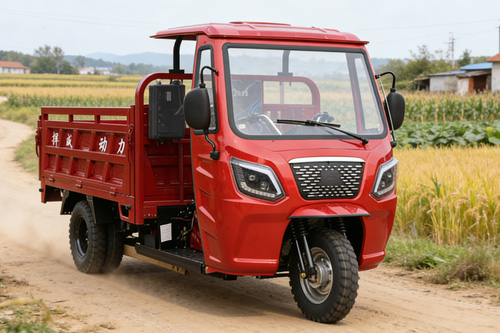
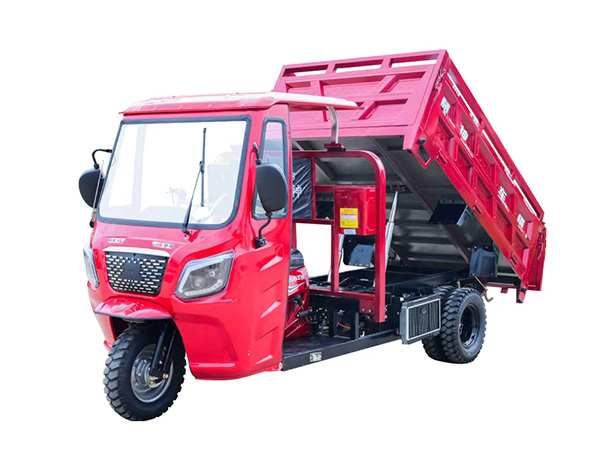
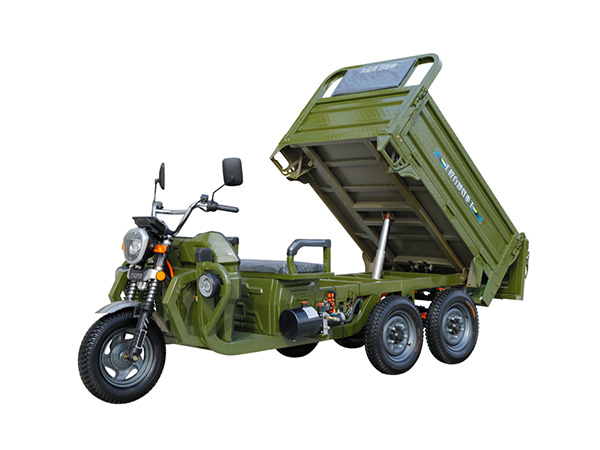
The dump bed construction tricycle is the workhorse of bulk material transport on active building sites. Its primary applications are moving sand, gravel, crushed stone, excavated soil, concrete mix, and demolition debris between storage, mixing, and placement points. The dump mechanism—manual lever or hydraulic cylinder—enables gravity-assisted unloading in 15–45 seconds, compared to 3–8 minutes for manual unloading from a flatbed. For a construction tricycle handling 500–700 kg of bulk material per trip across a 50–100 m site route, the dump configuration increases daily material movement by 3–5× compared to wheelbarrow transport. Hydraulic dump mechanisms (recommended for loads >400 kg) reduce operator unloading effort by 70–80% and enable controlled tipping for precise material placement in formwork or trenches.
Flatbed Models for Unitized Building Materials
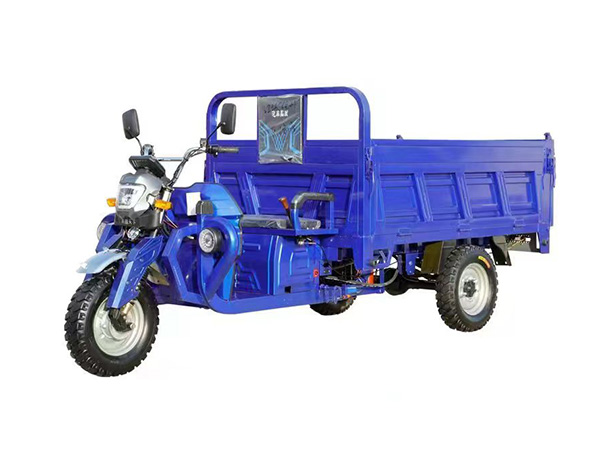
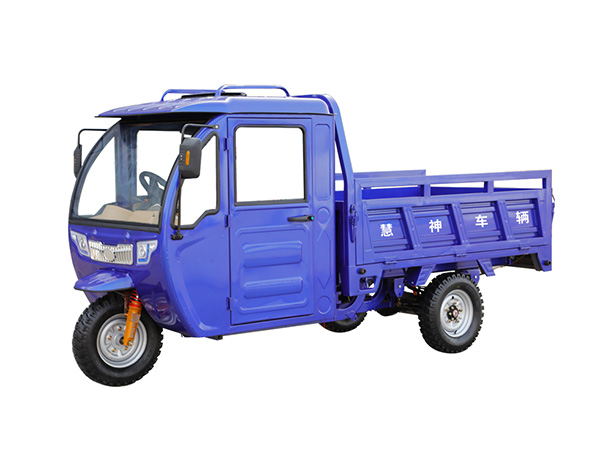
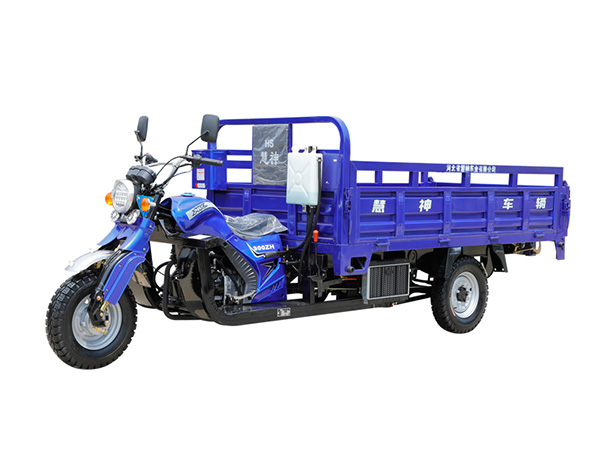
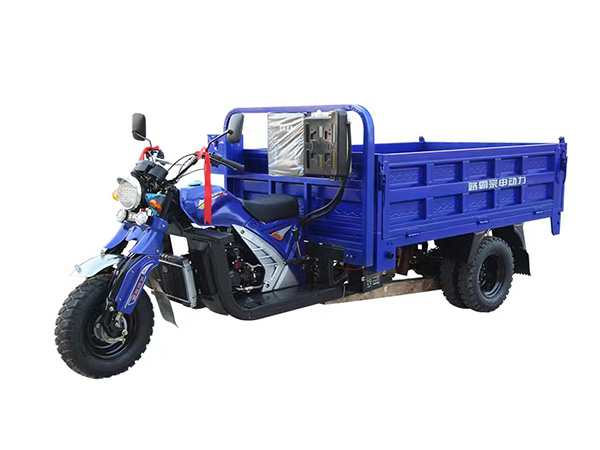
For unitized construction materials—cement bags, bricks, blocks, steel reinforcement bars, timber, roofing materials, and tool bins—a flatbed construction tricycle offers maximum flexibility. The flat platform accepts standard EUR (1,200 × 800 mm) or North American (1,200 × 1,000 mm) pallets, loose materials secured with ratchet straps, and custom cradles for specific material types (pipe racks, rebar cradles, lumber supports). Flatbed tricycles used in construction sites typically carry 300–600 kg on a 1,500 × 900 mm platform. For multi-story construction, the flatbed's compact dimensions (length ≤2,400 mm, width ≤1,000 mm) enable transport via standard construction elevators and material hoists for floor-to-floor distribution, eliminating manual carrying of materials from elevator landings to work points.
Heavy-Duty Frame and Component Specifications
Construction-grade tricycles require structural specifications 30–50% stronger than general industrial models. Key specifications include: frame material Q345 high-strength steel (yield strength ≥345 MPa) as baseline, with chromoly 4130 available for highest-duty cycles; reinforced gusset plates at head tube, seat tube, and rear dropout junctions; rear axle assembly rated for 1.5× maximum per-wheel load; 26-inch wheels with 6-ply tires (load index ≥85, 545 kg per tire); hydraulic disc brakes on all three wheels with minimum 180 mm front and 203 mm rear rotors; and a grease-able full chain enclosure to prevent dust and grit ingestion. The 15–25% cost premium for construction-grade specifications delivers 2–3× service life under site conditions, yielding a 3:1 return on the durability investment over a 5-year project cycle.
Multi-Story and High-Rise Material Distribution
A specialized application of tricycles used in construction sites is floor-level material distribution in multi-story construction. Materials delivered to a floor by crane or elevator must be distributed 20–100 m to specific work locations through partially completed corridors and rooms. A construction tricycle performs this function 3–4× faster than manual carrying and reduces repetitive strain injury risk. For high-rise deployment, specify: overall length ≤2,400 mm and width ≤900 mm to fit standard construction elevator cabins; total weight (vehicle + typical cargo) within the elevator's load rating; non-marking tires for finished floor protection; and low-voltage electric assist for safe indoor operation without exhaust emissions. Some high-rise projects deploy dedicated floor-level tricycles that remain on a single floor for the duration of that floor's construction phase.
Safety Protocols and Site Integration
Construction site safety regulations require that tricycles used in construction sites be operated under the same hazard management framework as powered material handling equipment. Essential safety measures include: operator training covering load securing, braking on slopes and loose surfaces, and stability awareness (minimum 4-hour training program); defined site traffic routes that separate construction tricycle paths from pedestrian walkways and heavy equipment zones; maximum on-site speed limits of 10 km/h on paved surfaces and 5 km/h on loose surfaces; and mandatory high-visibility clothing and head protection for operators. Sites implementing structured safety protocols for construction tricycle operations report 60–75% fewer material transport-related incidents compared to sites relying on ad-hoc wheelbarrow and manual carrying practices.
Frequently Asked Questions
What types of construction tricycles are available?
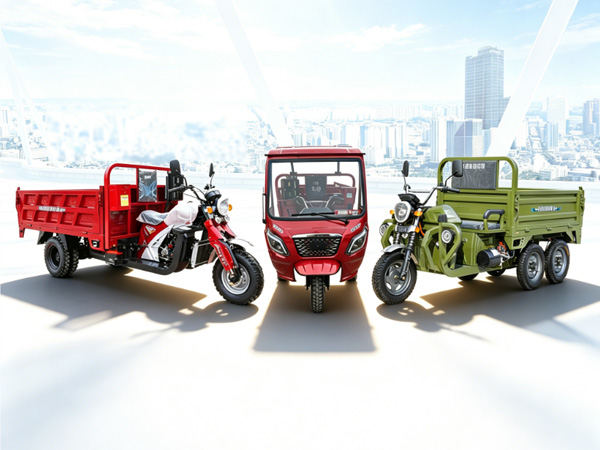
The three primary construction tricycles are: dump bed models for bulk materials (sand, gravel, soil, demolition debris), flatbed models for unitized materials (bricks, cement, timber, tools), and specialized rack models for long-length items (pipe, rebar, lumber). Dump beds dominate in earthwork and concrete phases; flatbeds dominate in structural and finishing phases with diverse material types.
How much weight can a construction tricycle carry safely?
Construction-grade tricycles are rated for 300–800 kg payload. For sustained daily use, apply a 20% derating factor: a tricycle rated at 600 kg is safely operated at 480 kg for daily cycles. Always verify that tire load index and rear axle ratings accommodate 1.5× the per-wheel load share of your maximum payload. Overloading is the primary cause of premature frame failure and wheel damage on construction sites.
Can construction tricycles operate on rough or unfinished surfaces?
Yes, with appropriate specifications. Construction tricycles with 26-inch wheels, 4–6 ply pneumatic tires, and ground clearance ≥150 mm operate effectively on compacted earth, gravel, and partially finished concrete. For very rough terrain, specify wide-tread tires (2.0–2.5 inch width) and reduce payload by 25–30%. Avoid operation on uncompacted fill, deep mud, or slopes exceeding 10° to prevent rollover and loss of traction.
What labor cost savings does a construction tricycle deliver?
A single construction tricycle replaces 4–6 wheelbarrow operators while maintaining or increasing material throughput. At an average labor cost of $50–$100 per operator per day (depending on region), the daily saving is $200–$600 per tricycle. At 20 working days per month, monthly savings reach $4,000–$12,000 per vehicle—recovering the $1,500–$3,500 purchase cost in under 2 weeks of full utilization.
Are electric construction tricycles suitable for dusty site conditions?
Electric construction tricycles operate effectively on dusty sites when specified with sealed electrical enclosures (IP65 rating), dust-proof battery compartments, and debris-shielded chain enclosures. The absence of an internal combustion engine is an advantage in dusty conditions: there is no air intake filter to clog, no oil to contaminate, and no exhaust to recirculate dust into the operator's breathing zone. Electric models are preferred for indoor construction phases and enclosed building sites.
Conclusion
The deployment of construction tricycles represents one of the highest-ROI investments available to construction project managers. A single vehicle pays for itself in under 2 weeks through labor cost savings alone, while simultaneously reducing worker fatigue and injury risk, improving material movement speed by 3–5×, and enabling continuous high-frequency transport that manual methods cannot match. The keys to success are specifying construction-grade durability, selecting the correct cargo configuration for your dominant material types, implementing structured safety protocols, and planning routes that account for site surface conditions and space constraints. For any construction operation moving more than 2,000 kg of material per day within the site boundary, the economic case for tricycles used in construction sites is unambiguous—and the productivity gains compound across every phase of the project.
References
Koskela, L., "Management of Production in Construction: A Theoretical View," Proceedings of the 7th Annual Conference of the International Group for Lean Construction, 1999.
Cheng, E.W.L. et al., "Construction Site Safety Management: A Review," International Journal of Project Management, vol. 31, no. 8, pp. 1117–1126, 2013.
Sacks, R. et al., Construction Quantity Surveying: A Practical Guide for the Quantity Surveyor, Wiley-Blackwell, 2015.
Hosseini, M.R. et al., "A Comprehensive Review of Site Logistics Planning and Optimization in Construction," Automation in Construction, vol. 103, pp. 216–233, 2019.

Contact Us
Tel:8615713172715 / 8619061777149
WeChat:8615713172715 / 8619061777149
E-mail:942778859@qq.com
Url:https://www.duomitricycle.com